

Black Ice and the Storm in Progress Rule in New York City Slip-and-Fall Cases
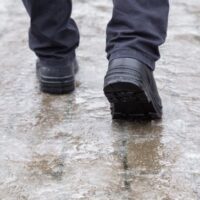
New York winters rarely deliver one clean storm followed by a dry week. Snow melts in the afternoon sun, runs across a sidewalk or building entrance, and refreezes overnight into a thin, nearly invisible sheet. Freezing rain can glaze a walkway in minutes. Many of the most serious winter falls in New York City happen on this kind of black ice, often at a building entrance, on a stoop, or on a sidewalk that appeared to be clear.
When someone is hurt, the property owner’s first defense is often the storm in progress rule. Whether the storm actually ended, and whether the ice that caused the fall came from that storm or from an older condition, can decide the case. An experienced New York City slip and fall lawyer can gather the weather records and property evidence needed to answer those questions.
The Storm in Progress Rule Suspends an Owner’s Duty During Bad Weather
New York law does not expect property owners to keep walkways clear while snow or freezing rain is still falling. In Solazzo v. New York City Transit Authority, the Court of Appeals confirmed that an owner will not be held liable for injuries caused by an icy condition that develops during an ongoing storm or for a reasonable time after it ends. The plaintiff fell at a Manhattan subway station on a day of on-and-off snow, sleet, and rain, and his claim was dismissed.
The rule applies to sidewalks, steps, parking areas, and building entrances, and courts have applied it to wet floors just inside a building when the water is tracked in from an ongoing storm. The reasoning is practical: clearing a surface while precipitation continues may be undone within minutes.
The rule is a defense, and the property owner generally carries the initial burden of proving it. Owners typically rely on certified climatological records and meteorologist affidavits to show that precipitation was falling at the time of the fall. Those same records are often where the injured person’s response begins.
When the Storm Actually Ends Matters
The protection lasts only for a reasonable time after the storm. Once precipitation has ended and conditions allow cleanup, the duty to address snow and ice returns. Disputes frequently center on the timeline: when the last measurable precipitation fell, whether later flurries amounted to a continuing storm, and how many hours passed before the fall.
New York City’s own rules offer a useful reference point. Administrative Code § 16-123 requires owners and others in charge of buildings to clear snow and ice from abutting sidewalks within four hours after snow stops falling, with overnight hours excluded. Under Department of Sanitation guidance, snowfall that ends in the evening or overnight must be cleared by the following morning. Courts evaluate reasonableness case by case, but an owner who did nothing for a full day after a storm ended will have difficulty relying on the rule.
Surfaces that cannot be fully cleared should still be made safer. City guidance directs that frozen snow or ice that cannot be removed be treated with salt, sand, or similar material to improve traction.
Black Ice Often Comes From Before the Storm
The storm in progress rule covers conditions created by the current storm. It does not protect an owner from ice that was already there. A fall during light snow may still support a claim if the ice underneath formed days earlier from an unremoved accumulation, melting snow piles, or an earlier freeze.
Weather history is central to that argument. Daily temperature and precipitation records can show thaw-and-freeze cycles in the days before the accident: daytime temperatures above freezing, meltwater, and a hard freeze overnight.
Combined with testimony that the ice looked old, was thick, or sat under only a dusting of new snow, those records can raise a question about whether the ice predated the storm the owner is relying on. Meteorologists are regularly retained by both sides to reconstruct these conditions hour by hour.
Why Black Ice Raises Difficult Notice Questions
Outside the storm context, a property owner is generally liable for a slippery condition only if it created the condition or had actual or constructive notice of it. Under Gordon v. American Museum of Natural History, constructive notice requires a condition that is visible and apparent, and that existed long enough for the owner to discover and fix it.
Black ice is dangerous precisely because it is hard to see, and owners often argue that an invisible condition could not have been discovered. The answer frequently lies in the source of the water. A leaking gutter, a downspout that discharges across a walkway, a clogged drain, condensation from building equipment, or a low spot in the pavement that collects runoff can produce the same patch of ice winter after winter. Evidence that an owner knew about a specific recurring condition can support notice even when the particular sheet of ice was hard to see.
The recurring condition must be specific. In Solazzo, the Court of Appeals held that general awareness that subway stairs and platforms become wet in bad weather was not enough. Complaints, work orders, photographs, and prior incidents tied to the same location carry far more weight than proof that ice is common in winter.
Snow Removal That Creates or Worsens the Hazard
An owner who begins clearing snow must do so reasonably. Liability can arise when removal efforts create or worsen the hazard: piling snow where meltwater will run across a walkway, clearing a narrow path that melts and refreezes into a sheet of ice, or plowing that leaves a packed, polished layer behind without salt or sand.
This theory can apply even during a storm. The storm in progress rule relieves owners of the duty to act, but it does not excuse conduct that makes conditions more dangerous than the storm alone would have. Snow-removal contractors can also face claims when their work creates the condition, depending on the terms of their contract and their control over the property.
Who Is Responsible for an Icy Sidewalk in New York City
Administrative Code § 7-210 places responsibility for maintaining most New York City sidewalks, including removing snow and ice, on the owner of the abutting property. The main exception covers one-, two-, and three-family homes that are at least partly owner-occupied and used exclusively as residences.
Commercial tenants, managing agents, and snow-removal contractors can share responsibility depending on their leases and contracts. Claims against the City of New York, NYCHA, and other public entities carry additional deadlines.
Under General Municipal Law § 50-e, a Notice of Claim generally must be served within 90 days, a short window for someone recovering from a fractured wrist, ankle, or hip.
Evidence Disappears With the Next Thaw
Ice is temporary. Within a day or two, the condition that caused a fall may have melted, been salted, or been buried under new snow. Photographs of the surface, the surrounding area, nearby downspouts and drains, and any snow piles should be taken as soon as possible, and the footwear worn that day should be kept.
Other evidence can be requested before it is lost: surveillance video from the building or neighboring businesses, snow-removal logs and contracts, salt purchase and application records, superintendent and porter schedules, 311 complaints, and prior incident reports.
Certified weather records from the National Oceanic and Atmospheric Administration, including observations from Central Park, LaGuardia, and JFK, can be obtained later, but they are most useful when matched against a timeline built while memories are fresh. Early legal guidance from an experienced New York City slip and fall lawyer can help connect the condition of the property with the weather history and determine whether the ice formed before the storm or developed from a recurring hazard.
Contact Mark David Shirian P.C. for a Free Consultation
If you slipped on black ice at a building entrance, sidewalk, parking area, or stairway in New York City, the property owner may blame the weather. Whether the storm had actually ended, and whether the ice came from an older or recurring condition, can determine whether that defense holds up.
Mark David Shirian P.C. represents people injured in slip-and-fall accidents throughout Manhattan, Brooklyn, Queens, the Bronx, and the rest of New York City. Contact us to speak with an experienced New York City slip and fall lawyer and learn how we can help you pursue compensation after a fall on snow or ice. Call the firm at 212-931-6530.
Sources:
- Solazzo v. New York City Transit Authority, 6 N.Y.3d 734 (2005), New York Court of Appeals
courts.state.ny.us/Reporter/3dseries/2005/2005_09658.htm - Gordon v. American Museum of Natural History, 67 N.Y.2d 836 (1986), New York Court of Appeals nycourts.gov/reporter/archives/gordon_amrican_museum.htm
- NYC Department of Sanitation — Snow and Ice Removal from Sidewalks
nyc.gov/site/dsny/what-we-do/snow-response/snow-laws.page - New York General Municipal Law § 50-e — Notice of Claim
nysenate.gov/legislation/laws/GMU/50-E - New York Administrative Code § 7-210 — Liability of real property owner for failure to maintain sidewalk in a reasonably safe condition. codelibrary.amlegal.com/codes/newyorkcity/latest/NYCadmin/0-0-0-4164
- New York Administrative Code § 16-123 Removal of snow, ice and dirt from sidewalks; property owners’ duties. codelibrary.amlegal.com/codes/newyorkcity/latest/NYCadmin/0-0-0-26213
- National Oceanic and Atmospheric Administration — Climate Data Online
ncei.noaa.gov/cdo-web/